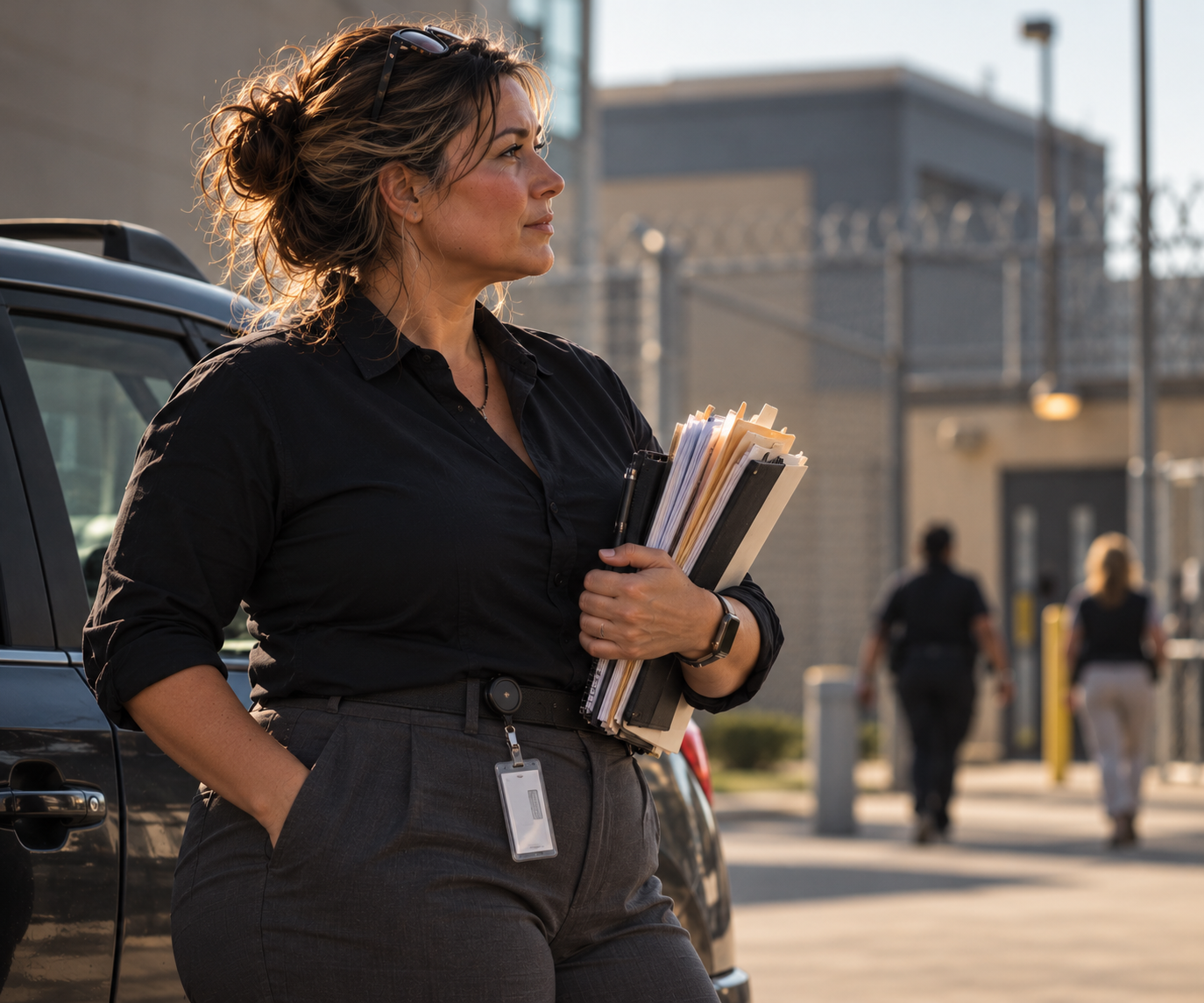
Patient: "Joanna" (name changed)
Age & bio: Perimenopausal woman, approximately 30 years into a demanding career in corrections, approaching retirement.
Presenting Complaint 🌿
When Joanna first came to see me, she had quite a few things going on.
Her primary complaint was persistent left knee pain and swelling. She'd been diagnosed with patellofemoral syndrome, had undergone joint aspiration and a cortisone injection, and was also dealing with significant arthritis in her hands, knees, and feet.
She was experiencing ankle swelling, fatigue, and considerable tension throughout her body, particularly on the left side.
On top of all this, she was navigating perimenopause, weight changes, and the frustration of feeling increasingly uncomfortable in her own body.
But the thing that really caught my attention wasn't her knee.
It was how exhausted she was.
Joanna has spent almost three decades working as a parole officer. She genuinely enjoys her profession, but the demands of her current role have become overwhelming.
She described feeling constantly revved up, with very little opportunity to recover between workdays.
She was also preparing for a major life transition. Retirement was approaching, and she was beginning to recognize that she couldn't continue operating at this pace indefinitely.
Clinical Course 🩺
During our initial assessment, I noticed considerable tension through her left side, including an elevated left shoulder and clavicle.
Her left knee had a persistent effusion, and she described the sensation of having a swollen inner tube wrapped around it, particularly when bending or kneeling.
We began with osteopathic manual treatment, addressing restrictions through her spine, pelvis, and lower extremities.
But we also spent time exploring her relationship with her body.
Joanna had previously practiced yoga, meditation, chanting, and breathwork. She was familiar with the idea that emotions and physical symptoms could be connected.
Interestingly, despite having explored these practices, she described feeling quite disconnected from her body's signals.
So during treatment, I invited her to bring her attention to her knee and simply describe what she noticed.
We weren't trying to change anything or make the sensation disappear. We were just getting curious.
As she focused her attention, she noticed sensations moving between different regions of her body.
We also experimented with spontaneous vocalization, encouraging her to make whatever sounds felt natural.
What I found fascinating was the immediate reduction in palpable tissue tension following the vocalization.
It was a simple intervention, but her body seemed to respond beautifully to it.
After that first treatment, Joanna reported feeling amazing. She slept well and experienced several days of relief, particularly in her knee.
However, she also experienced considerable fatigue afterward.
At her next appointment, she described feeling much less restricted, but her usual workload was still taking a toll.
By our third appointment, approximately six weeks later, she was really struggling.
She had taken a sick day because she simply couldn't face going to work.
She told me about a presentation she'd been giving at work where she suddenly felt so physically unwell that a colleague had to step in and finish for her.
She was also experiencing migraines, often on her days off.
And that was when a particularly interesting pattern began to emerge.
Clinical Reasoning 🤔
There were several layers to Joanna's presentation.
From a mechanical perspective, she had established joint pathology, persistent knee effusion, altered patellar mechanics, and significant tissue restrictions.
Her rheumatological conditions and perimenopausal changes were also important considerations.
But I was equally interested in the environment in which her body was trying to function.
Joanna was spending much of her week in a state of heightened vigilance.
Her work required constant attention, decision-making, and emotional regulation. She was responsible for managing complex situations involving other people's lives, often without adequate opportunities to decompress.
And when she finally had a day off, she would sometimes develop a migraine.
There's an interesting phenomenon known as a let-down migraine, where a reduction in stress can be associated with the onset of a migraine.
I wondered whether something similar might be happening with Joanna.
Her body was accustomed to operating under significant pressure, and the transition from intense activity to rest appeared to coincide with some of her symptoms.
We also discussed the concept of allostatic load, the cumulative physiological cost of adapting to repeated or prolonged stressors.
In Joanna's case, there were quite a few contributing factors: chronic occupational stress, persistent pain, inflammatory joint conditions, hormonal changes, and limited opportunities for recovery.
I didn't see her knee pain as simply an emotional issue.
But I did wonder how much her overall physiological load was influencing her pain experience and capacity to recover.
Another interesting detail was her response to a recent wellness day.
She'd attended hot Pilates followed by hot and cold therapy and described feeling better than she had in ages.
The following day, her mental clarity was noticeably improved.
By Tuesday, however, she was overwhelmed again.
That contrast was really telling.
It suggested that when Joanna had the opportunity to move, rest, and engage in activities that felt restorative, she could experience meaningful improvements in how she felt.
The challenge was finding ways to make recovery part of her regular life rather than something she could only access occasionally.
The Outcome ✅
We're still working together, so this is very much an evolving case.
Joanna has experienced improvements in tissue mobility, pain, and overall comfort following treatment, although the benefits have generally been temporary.
Her knee symptoms have shown some improvement, but the persistent swelling and underlying joint conditions remain important parts of her presentation.
One of the most encouraging developments has been her decision to transition out of her current community parole role and return to an institutional position, where she anticipates a more manageable workload.
We've also been discussing how she can incorporate small, realistic opportunities for recovery into her daily life.
Rather than prescribing an elaborate self-care routine, I've encouraged her to reconnect with practices she already enjoys, including meditation, movement, creative expression, and time in nature.
We've also discussed using vocalization and somatic awareness as tools for recognizing and responding to tension.
I'm particularly interested to see what happens as her work environment changes.
Will her migraines become less frequent? Will she have more energy? Will her physical symptoms become easier to manage when she's no longer operating under the same level of occupational pressure?
Time will tell.
Emotional Anatomy Reflection 🪞
One of the things I find most interesting about Joanna's case is that she isn't someone who doesn't understand the importance of self-care.
She knows what helps her feel better.
She's explored meditation, yoga, therapy, breathwork, and all sorts of wellness practices.
But knowing how to care for yourself and having the capacity to actually do it are two very different things.
And I think that's something we see quite often in clinical practice.
We have patients who are incredibly capable, responsible, and accustomed to taking care of everyone and everything around them.
They can manage a crisis, meet a deadline, solve a problem, and keep going when things get difficult.
But somewhere along the way, their own physical needs become something they attend to only when they can no longer ignore them.
With Joanna, I kept coming back to the idea that her body was never really getting an opportunity to clock out.
Even when she wasn't physically at work, she was carrying the cumulative demands of her professional life.
And I wonder how much of her identity has become wrapped up in being the person who can handle difficult things.
After nearly 30 years in corrections, what does it feel like to begin letting go of that responsibility?
What does retirement represent for someone who has spent so much of her life being needed?
And perhaps most importantly, can she begin to recognize her own needs before her body reaches the point of exhaustion?
These aren't questions I have the answers to.
But they're questions I'm interested in exploring with her.
Because while we continue addressing her physical restrictions and supporting her musculoskeletal health, I suspect that helping Joanna develop a different relationship with responsibility, rest, and her own needs may be an equally valuable part of our work.
Clinical Pearl 🦪
Sometimes our patients don't need another self-care strategy. They need help creating a life where self-care is actually possible.
I think it's easy for us as practitioners to recommend more movement, better sleep, meditation, stress management, and all the other things we know can support health.
But what happens when the patient is already overwhelmed?
What happens when adding one more thing to their day feels like another responsibility they have to fulfill?
With Joanna, I've been reminded that sometimes less really is more.
Instead of asking her to do more, we're exploring how she might create a little more space.
Space to recover.
Space to notice what her body is telling her.
And eventually, space to experience life outside the constant demands of her profession.
Reflection Question ✨
I'd love for you to think about a patient in your own practice who seems to respond well to treatment but struggles to maintain those improvements.
What might be happening in their everyday life that's making it difficult for their body to recover?
And perhaps more importantly, how could you help them recognize that pattern without giving them another thing to add to their already overwhelming to-do list?
I'd love to hear your thoughts, especially if you've noticed similar patterns in patients approaching retirement or navigating major professional transitions.
💛Geneviève
PS. Please feel free to share your thoughts/comments below!




Responses